The IEEE Eastern Europe Ferroelectric Symposium 2026 took place in Riga, Latvia, from June 1–4, 2026, attracting over 100 scientists worldwide. Organised by the Institute of Solid State Physics, University of Latvia, and sponsored by the IEEE UFFC Society, the programme featured 5 plenary talks, 22 invited lectures, 40 oral presentations, and 34 posters covering experimental and theoretical ferroelectrics research, with growing emphasis on AI and machine learning for microscopy and rapid materials discovery.
Ferroelectricity in hafnia dominated much of the scientific discussion. Prof. Beatriz Noheda (University of Groningen) opened up with a dedicated plenary talk, followed by Prof. Brian Rodriguez (University College Dublin) addressing progress in probing electromechanical properties via Piezoresponse Force Microscopy (PFM). Roger Proksch (Asylum Research, Oxford Instruments) complemented this with an overview of recent PFM advances enabling resolution of weaker piezoresponses in ferroelectric hafnia.
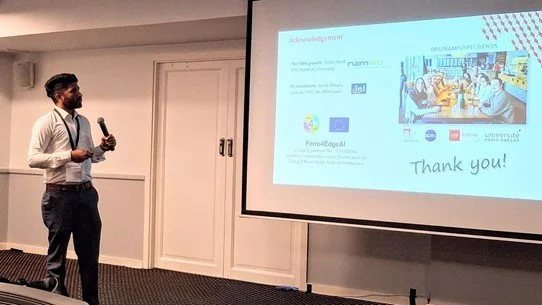
LENSIS Lab (SPEC, CEA Saclay) was well represented By Dr. Somnath Kale presenting his work on multilevel polarization switching in ferroelectric hafnium thin films and devices within the Ferro4EdgeAI framework. Following his oral presentation, an engaging discussion took place with Prof. Sergei Kalinin, and Prof. Brian Rodriguez expressed particular interest in future collaborations involving PFM on hafnia. Overall, the conference was a major success for outreach, disseminating research results, and networking with peers and future collaborators within the Ferro4EdgeAI consortium.